

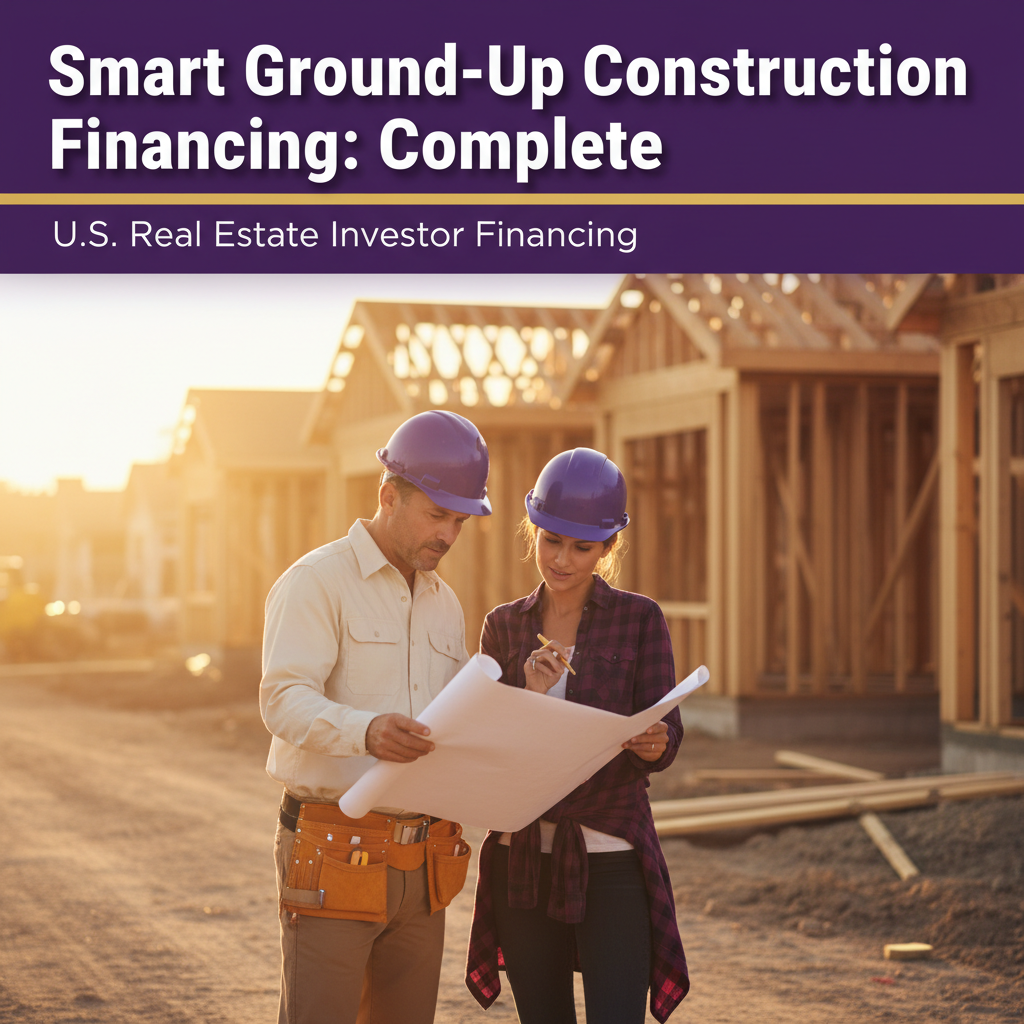
Financing a ground-up construction project for a 5+ unit multifamily or small commercial property involves a specialized, short-term loan. This loan covers land acquisition and construction costs, disbursed in stages, and is based on the project's future completed value. It is designed exclusively for experienced real estate investors building non-owner-occupied properties for business purposes.
These loans are interest-only during the construction phase and require a significant down payment, a viable project plan, and a clear exit strategy, usually a long-term refinance once the property is built and stabilized with tenants. As a mortgage broker, Simply Approved Mortgages arranges this financing with wholesale lenders who specialize in new construction for investors.
How investor construction financing works
Unlike a standard mortgage, a construction loan is a two-part process. You first secure a short-term construction loan to build the property. Once construction is complete and you receive a Certificate of Occupancy, you then secure permanent financing—often called a "takeout loan"—to pay off the construction loan.
The initial construction loan is not a lump-sum payment. Instead, funds are released in a series of payments called draws. These draws are tied to specific construction milestones outlined in a draw schedule. For example, you might receive a draw after the foundation is poured, another after framing is complete, and so on. An inspector verifies the work at each stage before the lender releases the next draw.
This structure protects both you and the lender. It ensures that loan funds are used directly for construction progress and helps keep the project on budget and on schedule. The loan is typically structured as interest-only, meaning you only pay interest on the funds that have been drawn, not on the total loan amount. This keeps your holding costs lower during the build phase. You can learn more about the complete process by reading our guide to financing an investor ground-up build from lot to certificate of occupancy.
What qualifies a borrower and a project
Lenders evaluate both the investor (the sponsor) and the project itself. For 5+ unit and commercial construction, the underwriting is significantly more stringent than for a single-family rental.
For the borrower, lenders look for:
- Experience. You will likely need to show a portfolio of successfully completed projects, whether they were heavy rehabs or prior ground-up builds. First-time developers will find it very difficult to secure financing for a multifamily or commercial project.
- Liquidity. You need substantial cash reserves. This covers your down payment, closing costs, and a contingency fund of 10-20% of the total construction budget for unexpected overruns.
- Credit. While these are not personal loans, your personal credit history still demonstrates financial responsibility. Most lenders look for a credit score of 680 or higher.
- Entity Vesting. The loan will almost always be made to a business entity, such as an LLC or corporation, not to you as an individual.
For the project, the lender's analysis focuses on its viability and profitability. The underwriting is based on the "as-completed" and "as-stabilized" value. They will require a detailed package including architectural plans, a line-item budget (hard and soft costs), permits or a permitting plan, a professional feasibility study, and a vetted general contractor with a strong track record.
The numbers: understanding costs and leverage
The amount you can borrow is determined by two key metrics: Loan-to-Cost (LTC) and Loan-to-Value (LTV). Lenders will typically approve a loan based on the lesser of these two calculations.
- Loan-to-Cost (LTC) is the loan amount as a percentage of the total project cost (land purchase plus all construction costs).
- Loan-to-Value (LTV) is the loan amount as a percentage of the After-Repair Value (ARV), which is the appraised value of the property once it is fully built and stabilized.
Here is an illustrative example of how the numbers might pencil out for a small 6-unit apartment building:
- Land Acquisition Cost: $250,000
- Hard Costs (materials, labor): $1,200,000
- Soft Costs (permits, architectural fees, insurance): $250,000
- Total Project Cost: $1,700,000
The lender's guidelines might be a maximum of 80% LTC and 70% LTV. An appraiser determines the "as-completed" value of the finished building will be $2,200,000.
- LTC Calculation: 80% of $1,700,000 (Total Cost) = $1,360,000
- LTV Calculation: 70% of $2,200,000 (As-Completed Value) = $1,540,000
The lender will use the lesser of the two figures, so the maximum loan amount would be $1,360,000. This means you, the investor, would need to contribute $340,000 ($1,700,000 - $1,360,000) in cash equity. This does not include the additional cash reserves required for interest payments and contingencies.
The draw schedule explained
The draw schedule is the backbone of a construction loan agreement. It is a detailed timetable for releasing loan funds that is agreed upon by you, your contractor, and the lender before closing. Each draw is tied to a verifiable stage of completion.
A typical draw schedule for a multifamily building might look like this:
- Closing/Land Acquisition: First draw may cover a portion of the land purchase.
- Foundation: Funds released after foundation is poured and inspected.
- Framing & Roofing: Next draw after the building's skeleton and roof are complete.
- Rough-in Mechanicals: Funds for plumbing, electrical, and HVAC installation.
- Drywall & Interior Finishes: Released as the interior starts to take shape.
- Final Finishes & Landscaping: Final draws for items like paint, flooring, fixtures, and exterior work.
- Certificate of Occupancy (C of O): A final holdback may be released upon receiving the C of O from the local building authority.
For each draw request, you or your contractor will submit documentation to the lender. The lender then sends an inspector to the site to confirm the work has been completed according to the plans and budget. Once verified, the funds are released. This process prevents funds from being paid for incomplete or substandard work.
Your exit strategy: the permanent takeout loan
A construction loan is a short-term bridge to a finished asset. The term is typically 12 to 24 months. Before the loan matures, you must execute your exit strategy: paying it off. The most common exit for a rental property is refinancing into a long-term, permanent loan.
Once the property is built, receives its Certificate of Occupancy, and is leased up to a certain occupancy level (often 85-90%), it is considered "stabilized." At this point, you can apply for a permanent loan. For most investors, this will be a DSCR loan.
A DSCR (Debt-Service Coverage Ratio) loan qualifies the property based on its own rental income rather than your personal income. The lender calculates the DSCR by dividing the property's Net Operating Income (NOI) by its proposed total mortgage payment (PITIA). A ratio over 1.0x means the property generates more income than it costs. Most lenders look for a DSCR of 1.20x or higher. You can learn more about how DSCR rental loans qualify a property on its own income.
This new DSCR loan pays off the entire balance of your construction loan, leaving you with a 30-year fixed-rate mortgage. You may also be able to do a cash-out refinance if the appraised value is high enough, allowing you to pull out some of your initial equity to fund your next project. This strategy is a key part of how many investors scale their portfolios, often using refinance proceeds to buy the next rental.
Risks and common pitfalls in multifamily construction
Building from the ground up carries higher risks than buying an existing property. Being aware of these risks is the first step to mitigating them.
- Cost Overruns: The final cost exceeds the budget due to rising material prices, labor costs, or unforeseen problems. A healthy contingency fund is your primary defense.
- Construction Delays: Weather, supply chain issues, and labor shortages can push your completion date back. This extends your interest-only payments and delays the start of rental income.
- Permitting & Entitlement Risk: Delays or denials from local zoning and planning boards can stall or kill a project before it even begins. Due diligence before purchasing land is critical.
- Interest Rate Risk: The interest rate available for your permanent takeout loan may be higher than what you projected 18 months earlier, impacting your final cash flow and DSCR.
- Lease-Up Risk: It may take longer than expected to find tenants and stabilize the property, especially in markets with fluctuating demand. According to the U.S. Census Bureau's quarterly home vacancy data, vacancy rates can shift based on broader economic conditions, affecting how quickly you can fill a new building.
Alternatives to ground-up construction
If a full ground-up build seems too complex or capital-intensive, there are other ways to add value and expand your portfolio.
Consider a "value-add" strategy, where you purchase an older, underperforming multifamily property and renovate it. This often requires less capital and a shorter timeline than new construction. Financing for the acquisition and renovation can be structured using a bridge loan or similar short-term financing, followed by a DSCR refinance once the renovations are complete and rents are raised.
Another option is to leverage the equity in your existing portfolio. If you have a rental property with significant equity, you could use a second lien versus a cash-out refinance to pull out capital for a down payment on another property. This can be an efficient way to fund acquisitions without the complexities of a construction project.
Who this is not for
Ground-up construction financing for 5+ unit and commercial properties is not a suitable strategy for everyone. This type of financing is generally not for:
- Inexperienced Investors: If you have not managed at least a few significant fix-and-flip or heavy rehab projects, lenders will not consider you for ground-up development.
- Investors with Low Liquidity: The cash requirements for the down payment, closing costs, interest reserves, and a large contingency fund are substantial.
- Owner-Occupants: This is business-purpose financing for non-owner-occupied investment properties only. You cannot use this type of loan to build a property you intend to live in.
- Projects in Unproven Markets: Lenders are hesitant to fund speculative projects in areas without a proven track record of rental demand and rising property values.
What to do next
If you are an experienced investor with a viable project, the first step is to assemble your team and your documentation. This includes your architect, your general contractor, and your financial paperwork. You will need a portfolio of your past projects, personal financial statements, and a detailed plan for the proposed build.
Before you commit to a land purchase, it is wise to speak with a knowledgeable mortgage broker. We can assess your project's initial viability, review your qualifications, and connect you with lenders whose programs match your needs.
To explore your financing options for a multifamily or commercial construction project, you can start an application on our secure portal or browse our other resources on multifamily loans and construction loans.
FAQ
Who qualifies for this type of financing?
These are business-purpose loans for non-owner-occupied investment property. Lenders look at the property's income against its full payment, plus credit, reserves, experience, entity structure, and property type. Guidelines vary by lender and change over time.
Can the loan be held in an LLC?
Entity vesting is common on business-purpose investor loans. Most lenders allow an LLC or corporation with a personal guarantee, subject to their entity documentation requirements and state rules.
Is Simply Approved Mortgages a lender?
Simply Approved Mortgages is a mortgage broker, NMLS #2620881, not a lender, bank, or government agency. Business-purpose investor financing is available only in eligible jurisdictions, subject to lender guidelines, underwriting and applicable licensing requirements.
Are these figures a quote?
No. Every rate, payment, ratio, and cost shown is illustrative and subject to credit review, appraisal, verification, lender guidelines, and full underwriting. Nothing here is an offer or commitment to lend.
What should I do after reading this guide?
Run your numbers in the DSCR calculator or deal analyzer, then ask a licensed loan officer to review the scenario. Keep comparing structures before you commit to one.
Sources
This government publication is cited for market and program background only. Business-purpose investor loans are private products that are not government-insured and are not governed by HUD, FHA or Fannie Mae rules; their terms are set by the individual lender. Simply Approved Mortgages LLC (NMLS #2620881) is a mortgage broker and is not HUD, FHA, or the CFPB, and is not affiliated with or endorsed by any government agency.
More from this guide series
Published articles from the same research cluster.

Investor guide
Budget Overruns, Change Orders and Construction Draw Delays
Budget Overruns, Change Orders and Construction Draw Delays: what underwriters check, the numbers that matter, and worked examples for rental investors.
Read guide
Investor guide
Builder Experience and Licensing on Investor Construction
Builder Experience and Licensing on Investor Construction: what underwriters check, the numbers that matter, and worked examples for rental investors.
Read guide
Investor guide
Exiting a Construction Loan Into Long-Term Rental Financing
Exiting a Construction Loan Into Long-Term Rental Financing: what underwriters check, the numbers that matter, and worked examples for rental investors.
Read guide
Investor guide
How Construction Draw Schedules and Inspections Work
How Construction Draw Schedules and Inspections Work: what underwriters check, the numbers that matter, and worked examples for rental investors.
Read guide
Investor guide
Interest Reserves and Carrying Costs During a Build
Interest Reserves and Carrying Costs During a Build: what underwriters check, the numbers that matter, and worked examples for rental investors.
Read guideContinue your research
Related investor guides
Topic guide
Financing an Investor Ground-Up Build, Lot to CO
Financing an Investor Ground-Up Build, Lot to CO: what underwriters check, the numbers that matter, and worked examples for rental investors.
Read guide
Investor guide
Property Condition Environmental and Third Party Reports
Property Condition Environmental and Third Party Reports: what underwriters check, the numbers that matter, and worked examples for rental investors.
Read guide
Investor guide
NOI, Vacancy Factors and Expense Ratios for Rental Investors
NOI, Vacancy Factors and Expense Ratios for Rental Investors: what underwriters check, the numbers that matter, and worked examples for rental investors.
Read guide